


Table of Contents
- Speed Rating and Control: How the Numbers Shape Your Throw
- ACL Cornhole Bag Speed Ratings Explained
- Dual-Sided Bags: Fast Side, Slow Side, One Bag
- Cornhole Bag Material Guide: Suede, Canvas, and Synthetic Fabrics
- How to Break In Cornhole Bags Without Wrecking Them
- Best Cornhole Bags for Speed and Control by Playing Style
- Climate, Humidity, and Bag Consistency: What Competitors Skip
- Conclusion: Matching Bags to Your Game, Not the Hype
- Frequently Asked Questions
Last Updated: September 10, 2026
Speed Rating and Control: How the Numbers Shape Your Throw
The best cornhole bags for speed and control aren't the fastest on the shelf, they're the ones whose speed rating matches your release, board surface, and shot. At Lucky Bags Cornhole, we build ACL-approved equipment for competitors, and the most common mistake we see is buying a 9-speed bag because a teammate swears by it.
Speed and control pull against each other: a hard-sliding bag is harder to stop on command, and a grippy bag is harder to push through a block. The rating system lets you pick your trade-off on purpose instead of discovering it mid-tournament.
The throughline: the number on the bag is a starting point, not a verdict. Fabric, fill, humidity, and break-in all shift real behavior. Below: the rating scale, dual-sided construction, materials, break-in, and matching a set to your game.
ACL Cornhole Bag Speed Ratings Explained
An ACL cornhole bag speed rating is a 1-to-10 scale describing how fast a bag travels across the board, with 1 as maximum grab and 10 as maximum slide. The American Cornhole League uses it on approved equipment so players can compare bags before throwing.
The scale is a communication tool, not a precision instrument. Two bags both stamped "7" can behave differently on the same board.
Reading the 1-10 Speed Scale
- 1-3 (slow): Heavy friction. Bags stop quickly, hold position, and resist sliding into the hole. Best for control-first players and windy outdoor play.
- 4-6 (medium): The working range for most competitive players. Predictable slide with enough grab to stop a bag where you aim it.
- 7-8 (fast): Low surface resistance. Bags slide through blocks and carry toward the hole. Demands a soft, repeatable release.
- 9-10 (very fast): Minimal friction. Built for players with precise touch who want runaway action on the board.
Moving up from a slower rating? Expect several sessions before your push and cut shots feel reliable. The rating tells you what to expect; your hand tells you whether it's right.
Dual-Sided Bags: Fast Side, Slow Side, One Bag
Dual-sided bags carry a different fabric on each face, so one bag gives you two speed profiles. Flip it and you change how it interacts with the board without changing your release.
It's the most useful design in competitive cornhole, and the one new players underuse.
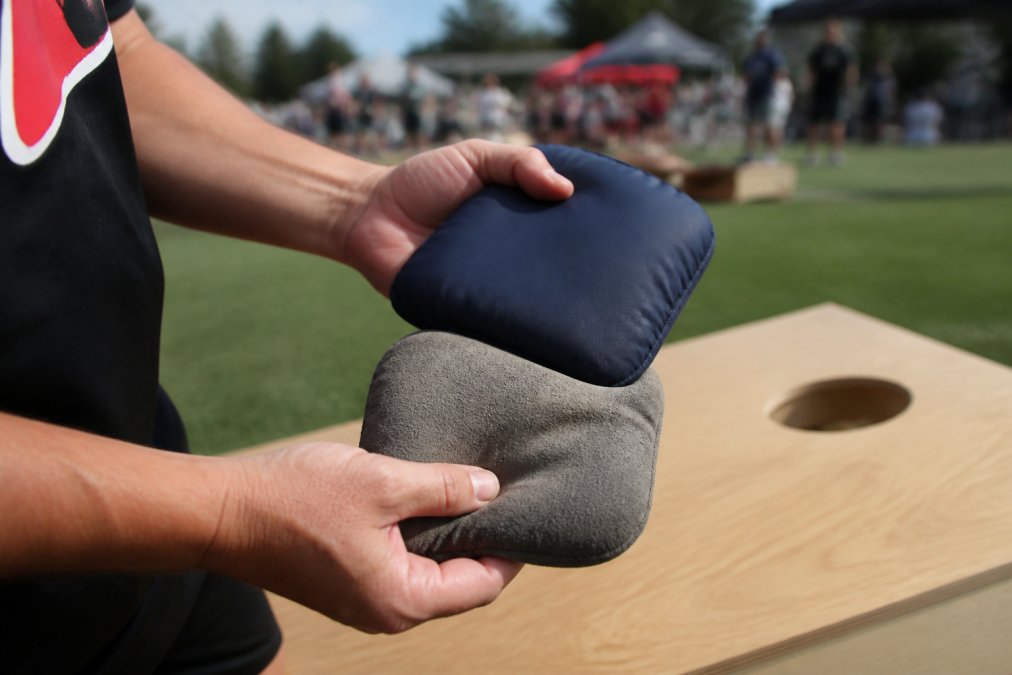
A typical dual-sided setup pairs a slicker synthetic face with a grippier suede or canvas face: the fast side slides and pushes blocks, the slow side controls and sits.
The benefit is tactical play: throw the same motion all game and change outcomes by controlling which face lands down. That consistency beats raw speed, because a repeatable release wins frames.
Cornhole Bag Material Guide: Suede, Canvas, and Synthetic Fabrics
Material composition decides how a bag behaves, and the cornhole bag material guide comes down to three families: suede, canvas, and synthetic fabrics. Each trades grip against slide through a different mechanism, and understanding that mechanism lets you predict how a bag changes over a season.
Suede is a napped leather or microfiber surface. Those tiny fibers brush against the board, creating high surface resistance that grabs and holds, making suede the grippiest common face and the control player's fabric. The trade-off: the nap mats down and traps dust, chalk, and moisture, so suede typically gets faster, not slower, as it breaks in. On dusty outdoor boards, expect the rating to drift upward over a weekend.
Canvas is a plain-woven cotton or cotton-blend duck. The tight, flat weave creates friction from texture rather than nap, giving canvas a balanced slide-to-grab ratio and predictable break-in: the weave softens gradually and evenly, so behavior changes slowly in one direction. Most players learn on canvas, and many never leave it because the feedback is honest.
Synthetic fabrics, polyester, nylon, or tight-weave blends, slide the hardest. Minimal nap and low surface energy let them glide across the board and carry toward the hole, and they resist moisture far better than natural fibers, holding their speed rating across a humid afternoon. The trade-off is forgiveness: a slick face amplifies a bad release, so an offline throw slides further offline instead of correcting.
Fabric Friction, Weave, and Fill: What Actually Changes Trajectory
Fabric friction sets how fast the bag decelerates. Fill sets how it settles. Together they decide trajectory, and the two interact more than most buyers realize.
Fine resin beads distribute weight evenly and flatten on impact for a predictable stop; coarser fill shifts and can roll on landing. Inside weight distribution matters as much as outside fabric, and it's the variable most buyers never check.
The interaction is what competitors skip. A slick synthetic face with fine resin beads gives the longest, most predictable slide. The same face with coarse fill can wobble or roll as fill shifts, reading as inconsistency. A suede face with fine fill grabs hard and stops short; with coarse fill it can slide slightly further because shifting fill keeps the nap from fully engaging.
Practical rule: match fill fineness to fabric speed. Fast fabrics reward fine, uniform fill; slow fabrics tolerate coarser fill because the nap does the stopping.
How Fabric and Fill Behave Across a Full Session
Fabric behavior isn't static. Three variables move it in a single day:
- Moisture uptake. Natural fibers (suede, canvas) absorb humidity and grip harder as they dampen; synthetics barely absorb, so their speed holds. That's why a canvas set can feel different at 8 a.m. and 4 p.m. on a muggy day.
- Surface contamination. Board dust, chalk, and sunscreen transfer to the bag face. On suede, contamination mats the nap and speeds the bag up; synthetics are barely affected because there's no nap to clog.
- Compression. Repeated impact compresses fill and flattens the face. Fine resin compresses slowly and evenly; coarse fill compacts unevenly, which is why cheap sets develop a "dead" bag mid-rotation.
For a set that holds its rating with minimal babysitting, synthetics with fine resin fill are lowest-maintenance. For maximum control and if you don't mind managing moisture, suede is the highest-grip option. Canvas is the middle path most league players settle into.
American Cornhole League official rules and equipment standards
How to Break In Cornhole Bags Without Wrecking Them
Breaking in cornhole bags means softening new fabric and settling the fill so the bag throws consistently. Skip it and tournament bags behave differently in week one than week six, a problem when every frame counts. Most guides miss that break-in isn't one method: it's a different method per fabric, and the wrong one wastes weeks or damages the bag.
The safe principle is the same across all fabrics: repetition, not force. Friction and impact do the work. Water, heat, and abrasion do the damage.
Break-In by Fabric Type
Suede. Suede needs the gentlest treatment because the nap is fragile. Throw on a clean, dry board 30 to 60 minutes per session, rotating which face lands down so both sides soften evenly. Never scrub suede against concrete or asphalt, that tears the nap and creates a permanently slick patch. Expect a stable feel in roughly 6 to 10 hours of play. Since suede grips more as it picks up moisture and dust, clean the face with a soft brush between sessions rather than washing it.
Canvas. Canvas is the most forgiving fabric to break in. Throw 45 to 90 minutes per session and rotate faces. It softens gradually and evenly, so behavior changes slowly in one direction and is easy to track. Expect 8 to 12 hours of play for a stable feel. If a canvas bag feels stiff, more throwing is the answer, canvas responds well to volume.
Synthetic. Synthetics break in fastest because there's no nap to soften, the change is mostly fill settling. Throw 30 to 45 minutes per session; expect 4 to 6 hours of play for a stable feel. The risk is over-handling: since the fabric barely changes, players sometimes force break-in by overworking the bag, compressing fill unevenly and creating a dead spot. Let the fill settle on its own.
A Step-by-Step Break-In Protocol
- Inspect before you throw. Check both bags weigh the same in hand and the fill doesn't clump to one corner. A bag that starts uneven stays uneven.
- Throw on a clean board only. Dust and grit accelerate wear on suede and embed in canvas; a clean board is the biggest factor in a controlled break-in.
- Rotate faces every 10 to 15 throws. Both sides need equal friction time, or you'll get a fast side and a dead side.
- Log your sessions. Note hours thrown and how the bag feels; most stabilize between 6 and 12 hours depending on fabric.
- Re-check weight and size consistency across the set. Bags that vary in fill weight throw differently even in identical conditions, and break-in is when that variance shows up.
- Store in a breathable bag, not sealed plastic, so residual moisture escapes between sessions.
How to Tell a Bag Is Fully Broken In
A bag is ready when three things are true: the fabric feels uniformly soft across both faces with no stiff patches, the fill moves as a single mass rather than shifting to one corner, and behavior is repeatable across a full session. If any is false, keep throwing.
If a tournament is coming up, break in a fresh set at least a week ahead. A bag still changing shape on match day is a liability, and the lead time lets you swap out one that isn't settling before it costs you a frame.
Best Cornhole Bags for Speed and Control by Playing Style
The right bag depends on how you throw, not what's trending. Match the rating to your release and you'll stop fighting your equipment.
Use this decision framework to narrow your choice:
| Playing Style | Recommended Speed Range | Fabric Direction | What It Fixes |
|---|---|---|---|
| Control-first / newer players | 3-5 | Suede or canvas | Bags sliding past the hole |
| All-around league play | 5-7 | Dual-sided canvas/synthetic | Inconsistent stops and blocks |
| Aggressive slide and block play | 7-9 | Synthetic, dual-sided | Bags dying short of the hole |
| Precision blockers | 4-6 | Suede fast side, canvas slow side | Blocks that won't hold position |
For one set that covers speed and control without compromise, Lucky Bags Cornhole builds dual-sided ACL-approved bags with customizable designs, so teammates with mixed styles can each dial in their own feel. Our sets are 2026 and 2027 ACL stamped, built from premium materials for pro-level consistency.
A common mistake is buying the fastest bag you can find and assuming control will follow. It won't. Buy the bag that matches your most common shot, then expand from there.
Climate, Humidity, and Bag Consistency: What Competitors Skip
Humidity changes how cornhole bags behave, and almost no equipment guide addresses it (weather.gov). Fabric absorbs moisture from the air, and a damp bag grips harder than a dry one, the same set can throw like a 5 indoors and a 3 outdoors on a humid evening.
Temperature matters less but still counts: cold fabric stiffens, and a stiff bag slides less predictably.
What this means in practice:
- Store bags in a climate-controlled space when you can.
- On humid days, expect more grab and adjust your release rather than your bag.
- Rotate between two sets so one has time to dry between sessions.
- Check weight and size consistency across your set. Bags that vary in fill weight will throw differently even in identical conditions.
Consistency across a set separates tournament-grade equipment from casual gear. If your bags don't feel identical in hand, they won't fly identically off the board.
National Weather Service humidity and dew point guidance
Conclusion: Matching Bags to Your Game, Not the Hype
The hardest part of buying cornhole bags isn't finding a fast set, it's admitting the fastest set may not be yours. Speed ratings, fabric friction, resin fill, and humidity all push on the same outcome, and winners match equipment to their release instead of chasing a number.
Lucky Bags Cornhole builds ACL-approved bags for exactly that player: dual-sided construction for speed and control in one bag, customizable designs so teammates can each throw their own profile, and premium materials that hold their rating season after season. Ready to stop guessing and start scoring? Browse the collection and add your set to the cart.
Frequently Asked Questions
What do the speed ratings on cornhole bags mean?
Speed ratings run on a 1-10 scale that measures how fast a bag slides across a board. A 1-3 bag grips early and suits control-focused players who rely on push shots and block shots. A 7-10 bag slides far and suits players who throw flop shots and cut shots. Most ACL-approved bags land between 4 and 8, so you get a bag that holds a line without sliding off the end.
How do I choose the right cornhole bag material for my playstyle?
Suede gives you the most grip and a slower, more predictable slide. Canvas sits in the middle and works for all-around play. Synthetic fabrics slide faster and resist humidity better, which matters at outdoor tournaments. If you throw mostly push shots, lean toward suede. If you throw flop shots, a synthetic or dual-sided bag gives you the speed you need.
Are ACL-approved bags necessary for competitive play?
Yes. ACL tournaments require stamped bags that meet size, weight, and material rules. A bag that is not stamped can get you disqualified before your first throw. Lucky Bags Cornhole carries 2026 and 2027 ACL Stamped bags, so you know the certification is current. Check the stamp date before you buy, since older stamps may not qualify for the current season.
How do I break in new professional cornhole bags?
Play them. Throw 100 to 200 practice shots on a clean board to soften the fabric and settle the resin fill. For suede bags, rub the slow side against the board to speed up the break-in. For synthetic bags, a few hours of play is usually enough. Avoid washing machines and harsh detergents, since they strip the fabric and change the speed rating.